



Introduction
Not every issue of this newsletter will be about becoming a millionaire with dollar-cost averaging, making the most of your free cash, or the tax-free magic of a Roth IRA. Now and then, I’ll share tips that don’t necessarily change my lifestyle, but will keep a few hundred extra bucks in my pocket.
With Black Friday around the corner - that magical time of year when people trample each other to save $40 on a TV they didn’t even want until Tuesday - I thought it would be a good time to share some of my credit card hacks that often save me hundreds of dollars a month. This includes tracking your existing credit card perks, plus a simple way to save even more on purchases that many people overlook: credit card offers.
I’m not just talking about the usual 2% or 3% cash back (or 6% if you’re paying attention to my previous issues) you earn for just swiping a piece of plastic. I’m talking about additional offers from credit card companies that can give you 10%, 20%, or sometimes even more back on purchases at places you actually shop and eat.
In this issue, I’ll cover how to use these offers, how to stack them with Black Friday deals, and specific ways I’ve used them.
A quick reminder, because the lawyers told me to: this is not financial advice. I am not a fiduciary, a CPA, or even particularly good at assembling IKEA furniture. This is just me sharing my strategies, investments, stocks, index fund strategies, what I'm buying, and where I plan to take those investments. Everyone’s financial goals are different. Some of you might want a yacht; others just want to stop looking at their 401(k) statements. No financial decisions should be made solely on this newsletter, which is for informational and entertainment purposes only and is not a substitute for advice from a qualified professional who actually knows your situation and charges by the hour.
Also, if you find this newsletter helpful, please share it with one friend who might find it useful by using the button below.

First, a VERY Important Rule About Credit Cards
Before we get into the fun stuff, I want to make something very clear. As I’ve mentioned ad nauseam in this newsletter, I only use credit cards because I pay off my entire statement balance every month. I don’t carry a balance, and I don’t pay credit card interest. If I can’t afford to pay for something outright, I shouldn’t be buying it with a credit card.
Credit cards can be fantastic financial tools if you use them right. They can also be fantastic tools for making banks richer if you use them wrong.
Let’s say you have a credit card with a 25% annual interest rate. You spend $5,000 and earn 2% cash back, or $100. If you carry that $5,000 balance for a year, the interest could easily exceed $1,250, depending on your payments and how interest is calculated.
You end up with $100 in rewards, but have potentially paid more than $1,250 in interest. Somewhere, a bank executive is buying a new boat and would like to personally thank you.
If you’re carrying credit card debt, stop reading this and check out my newsletter on strategies for paying it off. Paying off that debt should be a much higher priority than chasing credit card rewards.
The only thing worse than paying full price for something is paying full price for it again in interest.
Keep Track Of Your Credit Card Perks
A lot of people are leaving money on the table by not taking advantage of the perks that already come with their credit cards. Many credit cards, particularly travel and premium rewards cards, come with benefits that can save you hundreds of dollars a year. The problem is that many people don’t even know what benefits their cards offer.
Depending on what’s in your wallet, you may have Global Entry or TSA PreCheck credits, rental car collision coverage, dining credits, streaming rebates, cell phone protection, free checked bags, extended warranties, and more.
For instance, we travel a lot and finally decided to bite the bullet and sign up for Global Entry because standing in the regular customs line makes me lose faith in humanity. I have a United Quest card, while my wife has a United Explorer card, and both reimburse the Global Entry application fee. We applied, paid with our respective cards, and boom! The statement credits showed up almost immediately, and we saved a total of $240 simply by choosing the right credit cards:

As a bonus, Global Entry includes TSA PreCheck benefits for eligible members. So now I can spend less time standing in airport lines and more time complaining about the price of airport food.
Keeping track of what benefits come with what card can be simple. Next time you’re about to spend an hour mindlessly scrolling on your couch, log into your credit card accounts instead and potentially save hundreds a year.
Look for the “Benefits” or “Rewards and Benefits” section and make a list of the perks you can actually use, when they expire, and whether they require enrollment. Banks love hiding free money behind a button you forgot to press. You might realize you’re paying out of pocket for subscriptions or perks your card already covers.
Personally, I keep a Google Doc listing each card and its features. It may sound like a pain, but we don’t get new cards that often, so it’s just a matter of spending 10 minutes to update the doc when we get a new one. It’s pretty basic and looks like this (partial screenshot):
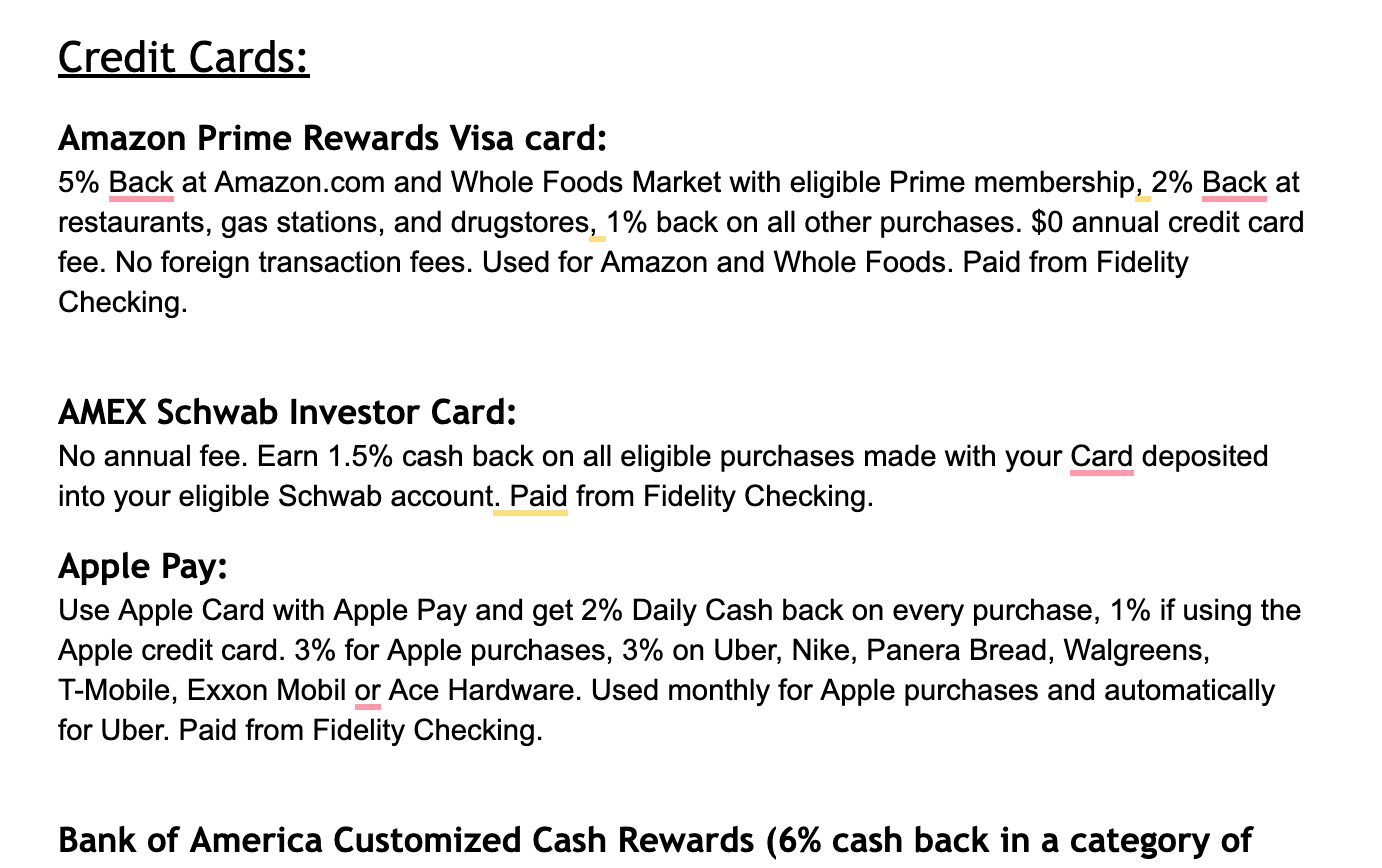
A Reddit user created a free benefits tracker spreadsheet which you can download here. I actually just found it while researching for this newsletter, and as seen in the partial screenshot below, it’s way more advanced than my simple Google Doc:

I may need to upgrade to this spreadsheet. Apparently, there are people even nerdier about this stuff than I am. I’ve found my people.
Regardless of what you use to track your benefits, it can be worth your time. You may be surprised to discover that you’re already receiving benefits that you’ve been paying for separately. Don’t donate unused perks back to multibillion-dollar financial institutions. They’re doing just fine without your help.
For example, before paying an extra $30 a day for collision damage coverage on a rental car, check whether your credit card already provides it. On a weeklong vacation, that could save you $210. Just make sure you understand the coverage, exclusions, and whether it’s primary or secondary insurance. Credit card rental car coverage generally doesn’t cover liability.
Also, if you’re buying expensive electronics on Black Friday, check whether your card offers extended warranty or purchase protection. Some cards will extend an eligible manufacturer’s warranty by an additional year or cover certain purchases against theft or accidental damage for a limited period. That might save you from buying the extended warranty that the salesperson at Best Buy is determined to sell you, regardless of how many times you say no.
One final note: if you’re paying a hefty annual fee for a credit card, make sure the benefits you actually use justify the cost. A card with a $500 annual fee and $800 worth of advertised perks isn’t saving you $300 if you only use $200 worth of them. You’re just paying $300 a year for a fancy piece of metal.
Extra Savings With Credit Card Offers
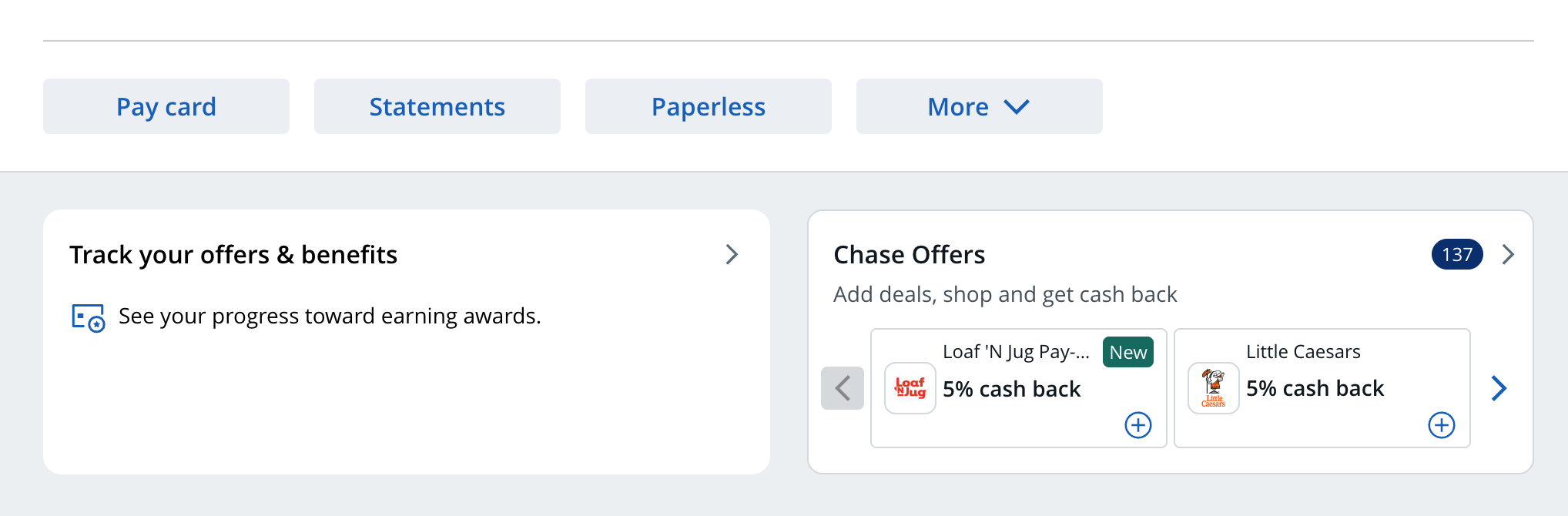
You learn something new every year.
In addition to the perks mentioned earlier, many credit card companies offer additional discounts at specific retailers and restaurants. You can usually find these offers by logging into your credit card account or mobile app.
For years, I completely ignored that little “Offers” box that pops up whenever I check my Chase credit card balances. I assumed it was just digital junk mail trying to convince me to buy something I didn’t need. Turns out, some of that digital junk mail was worth actual money.
Earlier this year, I received a 40% off mailer for Tommy John, which is my go-to brand for sleepwear. Around the same time, one of the offers that was showing up when I logged into Chase was 15% off at Tommy John. I assumed I had to pick one, because corporations rarely let you double-dip, but nope. I could use both; I just had to activate the offer and make the purchase with my Chase credit card. I was really proud of myself since I’m at that age where getting a great deal on pajamas is genuinely exciting.
One of the best parts of these offers is that they can often be earned on top of your credit card’s regular cash back or points. For example, if your card earns 3% back on dining and you activate a 15% restaurant offer, you could effectively get 18% back on your meal, assuming the entire purchase qualifies.
Just this week, American Express had an offer for $49 back on a one-year Walmart+ membership ($98 before taxes). I’d already been considering Paramount+, which costs around $90 annually for the plan I wanted. Since Walmart+ includes an eligible Paramount+ subscription, I ended up paying about $50 for Walmart+ after the statement credit and getting Paramount+ included.
I essentially got the streaming service I wanted for less money, with a Walmart+ membership thrown in. It’s like paying for parking at a Broncos game for half-price and getting tickets for the game thrown in. I’m not going to argue.

Last month, American Express also offered $20 back on a $100+ purchase at Benihana. Coincidentally, my niece’s birthday dinner was there. So I got to watch a guy flip shrimp into his hat, get $20 back, and earn my regular Amex points.
Dinner and a show, with a partial refund. Pretty sweet.
And it’s not just Chase and American Express. My Bank of America Customized Cash Rewards card has a “Deals” section (direct link), while my Capital One Savor card has an “Activate Shopping Offers” area. Meanwhile, my Fidelity Rewards Visa and Robinhood Gold Card don’t currently show me the same type of merchant offers. Offers vary by card, and some require activation while others require shopping through a specific link. So check your accounts and read the terms before making a purchase.
How Do Credit Card Offers Work?
The process is generally pretty simple.
Log in to your credit card account or mobile app.
Find the section for merchant offers or deals.
Scroll through and see what doesn’t look like total garbage.
Activate or add the offers you’re interested in to your card, or use their specific shopping link.
Buy the thing with that exact card before the offer expires.
Wait for your statement credit or points to roll in.
One important thing to remember is that many offers need to be activated before you make the purchase. Buying a couch and clicking “Activate” three days later won’t work. Unfortunately, credit card companies aren’t particularly interested in rewarding you for discovering their offers three days too late.
Also, offers can vary between cards, even cards from the same bank. If you have multiple cards, check the offers on each one. And make sure to read the fine print. Some offers are only valid online, some require a minimum spend, some cap the total cash back, and others are only valid at specific locations. A 20% cash back offer with a maximum reward of $5 is considerably less exciting than it sounds in the giant font they use to advertise it.
How Much Can You Actually Save
Let’s look at an example of how a household might take advantage of credit card offers during a month.
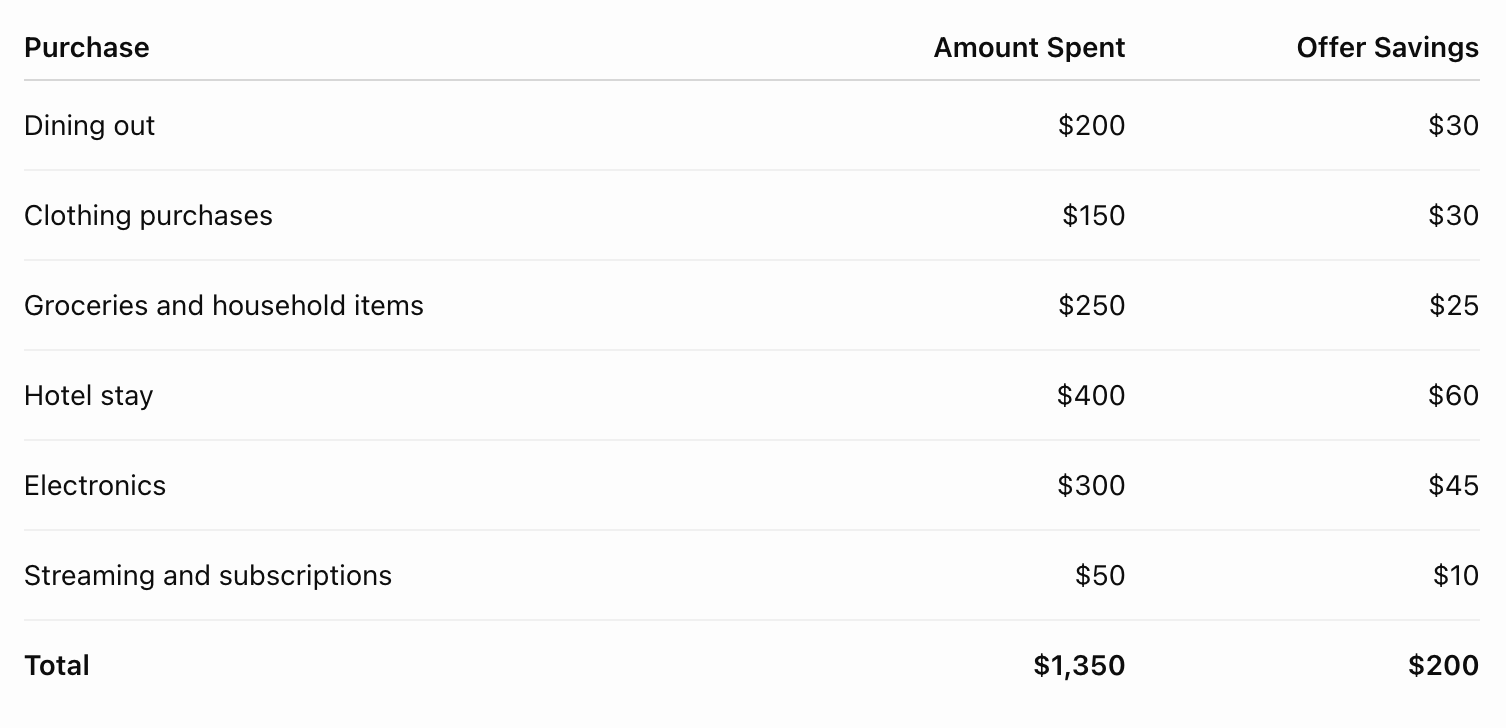
That’s $200 in additional savings on stuff you were buying anyway.
Now, let’s assume the credit cards used for these purchases also earn an average of 3% in regular cash back or equivalent rewards. That’s another $40.50.
Total savings and rewards: $240.50
For purchases where I don’t have a better offer, I often use my Robinhood Gold card, which earns 3% cash back on eligible purchases. But if another card has a particularly good merchant offer, I’ll use that card instead.
Of course, you’re not necessarily going to find $200 worth of useful offers every month. Some months might only save you $20 or $30, while months involving travel, holiday shopping, or larger purchases could save you considerably more.
For instance, my Function Health membership ($365 / year) just came up for renewal. American Express has an offer for a $100 statement credit on Function Health, plus my regular card rewards. That’s $100 saved for clicking a single button on my phone.
It takes almost zero effort, and over a year, it adds up to real money.
Keeping Track of Offers
This is the part my wife probably doesn’t want you to see, because she finds it deeply uncool. Fortunately for you, my dignity left the building years ago.
Juggling offers across multiple cards gets messy fast. You could build an elaborate spreadsheet, or you can do what I do: keep a running list in the Notes app on your phone. I jot down the store, the expiration date, and which card has the offer, as seen in the partial screenshot below (BTW, the Apple 9% offer is no longer available):
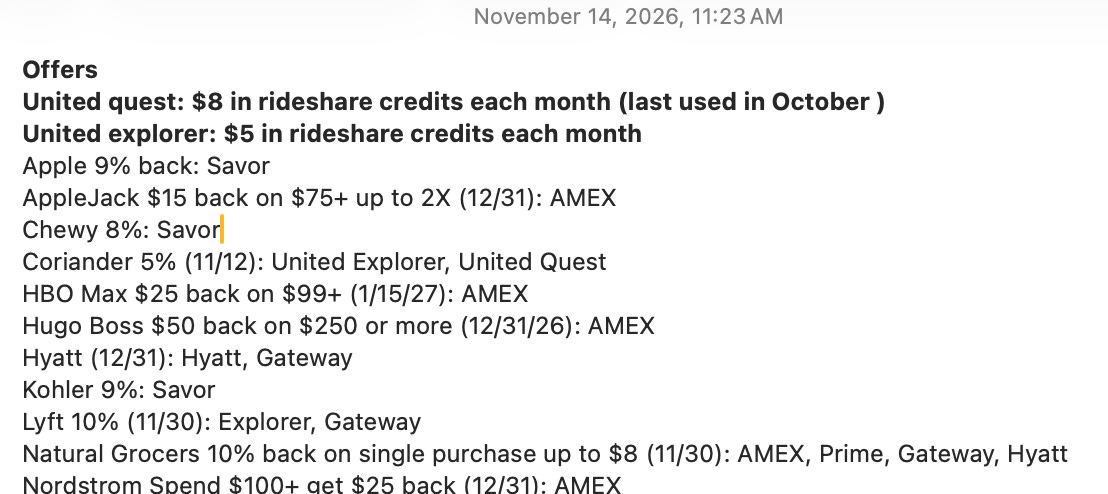
Is it the most technically advanced solution? No. Does it save me hundreds of dollars? Yes. On to the next section.
The Golden Rule
This is probably the most important part of this entire newsletter: A credit card offer should save you money, not trick you into spending money you weren’t.
If you’re planning to go out to dinner at a restaurant and your credit card has an offer for 20% cash back at that restaurant, awesome! If you weren’t planning to go out to dinner but decide to spend $100 because you have an offer for $20 back, you didn’t save $20. You spent $80.
The same goes for minimum spend thresholds. If you need an $80 jacket and there’s a “Spend $150, get $25 back” deal, do not throw $70 worth of random socks into your cart just to unlock the reward.
I personally focus on offers for:
Restaurants I already go to.
Grocery stores and household essentials.
Rideshares (Uber / Lyft).
Clothing stores I normally shop at.
Travel I was already planning.
Subscriptions I already pay for.
Gifts and other purchases I was already budgeting for.
Case in point: I already have a YouTube Premium subscription because I refuse to watch two unskippable ads just to see a 30-second video on how to fix a leaky faucet. A number of our Chase cards (which include United Quest, United Explorer, Marriott Bonvoy, etc.) offered 50% back on YouTube Premium for up to two billing cycles each. So for the last six months, I’ve just been rotating which card pays the bill every two months. Half-price YouTube Premium for much of the year, zero lifestyle changes.
Same with Lyft. My wife and I take a lot of airport rides, and Chase frequently runs 10% back offers on Lyft. We just make sure the right card is set as the default payment method.
The goal is to get rewarded for your existing spending habits. Don’t invent new ones just to chase a rebate.

An Extra Black Friday Tip
This has nothing to do with credit cards, just a personal Black Friday survival tactic.
When people think of Black Friday, they picture flat-screen TVs, PlayStations, and air fryers. Meanwhile, the real pros are stocking up on boring adult necessities that quietly go on massive discounts: vitamins, furnace filters, protein powder, skincare, and household supplies.
Right now, I’m going through my house, finding everything I’m going to run out of in the next month or two, tossing it into my Amazon cart, and hitting “Save for later.” When Black Friday hits, I just scroll through that list and buy whatever has genuinely dropped in price.
Currently sitting in my cart: protein powder, creatine, dog treats, face lotion, vitamins, beard oil, Meyer’s hand soap refills, and hair styling cream. Nothing screams “holiday spirit” quite like saving $3 on beard oil.
One thing to keep in mind: a big red “SALE” label doesn’t necessarily mean something is cheaper than it was last week. I like to keep track of the prices beforehand or use a price history tool like CamelCamelCamel to see whether I’m actually getting a good deal. Some retailers have a remarkable ability to discover that an item is worth twice as much right before they put it on sale.
Also, don’t stock up on so much stuff that it expires before you can use it. Buying a three-year supply of discounted vitamins that expire in six months isn’t a savings strategy. It’s a very specific type of hoarding.
Also Read
Laddering It All Together
I used the term “laddering” because I’m a personal finance dork (my newsletter on laddering bonds and CDs is here). A normal human being would just call it "stacking."
Black Friday is where credit card offers can become particularly valuable because you can potentially combine them with discounts that retailers are already offering.
Suppose you’re buying $500 worth of holiday gifts from an online retailer. Here’s a hypothetical example of how you might layer discounts and rewards for Black Friday.
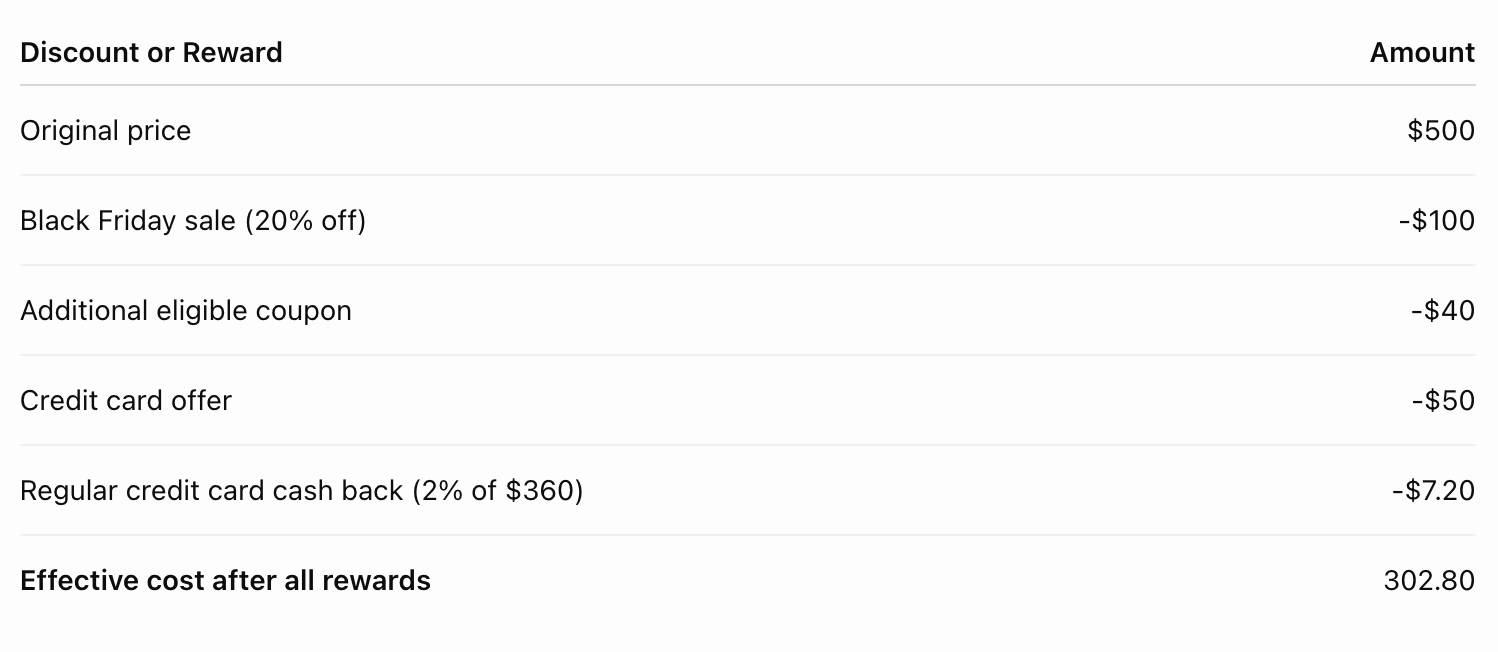
That’s potentially $197.20 in total discounts and rewards, or nearly 40% of the original price.
Your actual checkout price would be $360 before taxes and shipping. The remaining savings would come later through your credit card rewards and statement credit.
Granted, this is an optimal scenario. Not all coupons and offers can be combined, and you need to make sure your purchase qualifies for each promotion. But even if you only manage to get half of these savings, you’re still coming out way ahead.
Just make sure you check the minimum purchase requirements after any coupons are applied. A “Spend $400, get $50 back” offer isn’t going to do you much good if your final checkout total is $360. The credit card company is not going to round up because you tried really hard.
Also, keep an eye on your credit card statements afterward to make sure the credits actually post. Some appear quickly, while others can take several weeks.
💡 Practical Money Trivia
The IRS generally doesn’t consider credit card rewards taxable income. Cash back and points earned from buying stuff are treated as rebates (a discount on what you spent), so Uncle Sam leaves them alone. However, rewards received without a spending requirement, such as certain referral bonuses, may be taxable.
Conclusion
I’m all about making your money work harder so you don’t have to. Usually, that means dumping cash into index funds, hunting down high-yield savings rates, or maxing out tax-advantaged accounts.
Other times, it’s literally just checking your credit card app on your phone before you pay the dinner tab.
Credit card offers won’t make you rich overnight. You’re not retiring to Boca Raton on 15% back at Benihana. However, consistently pocketing an extra $100 to $200 a month on things you were already buying moves the needle over time. If you took that extra $200 a month and invested it at an 8% average annual return, you could potentially end up with roughly:

Nearly $300,000 over 30 years. Not bad for a financial strategy that started with getting a discount on pajamas. Suddenly, spending 30 seconds scrolling through your Chase offers doesn’t seem like such a small thing. Just remember the two golden rules:
1. Never pay credit card interest just to earn rewards.
2. Never buy something you don’t need just because it’s on sale or comes with a reward.
The best deal on something you don’t need is still not buying it. Happy Black Friday shopping!
That's it for this week! As always, no financial decisions should be made solely on this newsletter, which is for informational and entertainment purposes only and is not intended to be a substitute for advice from a professional financial advisor or qualified expert. If you haven’t already, please subscribe to this newsletter below and never miss an update: